You show up Monday morning and the gate chain is cut. A spool of copper wire is gone, and so is a generator. Now the crew is waiting, the schedule slips, and you are on the phone with your insurance company. If you run or own a job site in the Seattle area, you have probably asked the same question many builders ask: what is the best way to stop this from happening again?
There are three common answers: a security guard, a camera trailer, or permanent cameras. Each one works. Each one also has limits. This guide walks through all three in plain terms so you can pick the right fit for your project, or the right mix.
Why are construction sites such easy targets?
Job sites have a lot going for a thief. Tools, copper, wire and small equipment are easy to carry off and easy to resell. Fences go up and come down. The layout changes every few weeks. And for most of the night, nobody is there.
Getting stolen gear back is also hard. An older joint report from the National Insurance Crime Bureau and the National Equipment Register found that only about one in five stolen heavy machines was ever recovered. That is why most owners focus on stopping theft before it happens, not on finding things afterward.
The Seattle area adds a few challenges of its own:
- Long, dark winters. In December it can be dark before 4:30 p.m. That means more hours each day when the site is empty and hard to see.
- Rain and gray skies. Equipment has to keep working through months of wet weather.
- Lots of active projects. With so much building going on around Puget Sound, thieves have plenty of sites to choose from. A site that looks watched often gets skipped.
Option 1: A security guard
A guard is a real person on your site. That has real benefits. A guard can walk the fence line, check that gates are locked, and talk to anyone who shows up. Some contractors also like having someone present to handle late deliveries.
The downsides are mostly about coverage and cost:
- One person, one place. A guard can only watch one part of the site at a time. On a large site, the far corner may go unseen for long stretches.
- Hours add up fast. Industry guides often put guard services at roughly $20 to $35 per hour. Overnight coverage alone is 12 or more hours a night. Round-the-clock coverage is about 720 hours a month, which at those rates can run well over $10,000 a month.
- People need breaks. Shift changes, breaks and bad weather all create gaps.
Guards make the most sense for short, high-risk periods, or for sites where someone needs to let people in and out at night.
Option 2: A solar camera trailer
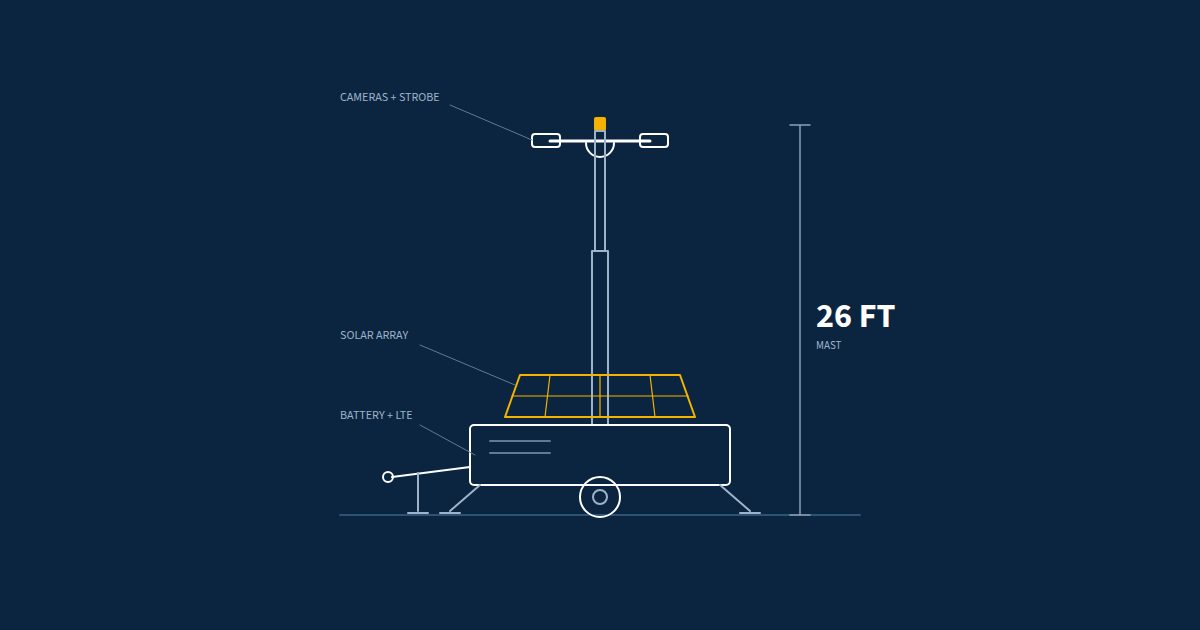
A camera trailer is a tall camera tower on a towable base. It brings its own power and its own internet connection, so it can be set up almost anywhere on a site, even on a bare lot.
The trailers we rent have:
- A 26 ft mast, so the cameras see over fences, stacks of material and parked equipment.
- One PTZ camera (a camera that can turn and zoom in on what it sees) and two fixed 4K cameras (very sharp, high-detail video).
- Solar panels with batteries that last about a week without sun. That matters during a gray Seattle November.
- A cellular connection, which works over the cell network, like a phone. No site power or internet is needed.
The real value comes from pairing the trailer with 24/7 remote video monitoring. When the cameras pick up activity, our security team checks the video and calls the police when it is a real incident. Where speakers are set up, they can also talk to the person and tell them to leave. That turns a camera into a response, not just a recording you watch on Monday.
On cost, industry guides often put trailer rentals at roughly $1,000 to $3,500 per month, with monitoring commonly adding a few hundred dollars a month on top. The price depends on the term, the equipment and what is included, so always compare quotes line by line. You can read more about how our trailers work on our mobile surveillance trailers page.
Option 3: Permanent cameras
Permanent cameras are mounted to the building or to poles and wired into the building’s network. They are the long-term answer. Once the building is enclosed and has power and internet, a permanent system can keep protecting it after you hand it over to the owner or property manager.
The catch is timing. Early in a project there is usually no power, no network and nothing solid to mount cameras on. That is why many projects use temporary options first and switch to permanent cameras near the end.
There is also a middle ground: camera poles. A solar camera pole runs on its own power, and a powered camera pole connects to site power. Both can cover a gate or a storage yard without a full trailer.
Which one is right for my job site?
Here is a simple way to think about it:
- Early phases (site work, foundations, framing): A monitored solar trailer is often the best fit. There is no power yet, and the site layout keeps changing. A trailer can be moved as the work moves.
- High-risk weeks (big deliveries, copper and wire on site): Some sites add a guard for a short stretch on top of cameras.
- Late phases and handover: Plan for permanent cameras and access control so the building is protected from day one of occupancy.
Many sites do best with a mix. For example, a trailer watches the material yard all night while a guard covers the gate during a short, busy period. Our Total Security approach puts cameras, monitoring, access control and the network under one team and one plan, so nothing falls through the cracks between phases.
Simple steps that help no matter what you choose
- Lock tools and wire in containers, and keep them out of view from the street.
- Park equipment where cameras can see it, not in back corners.
- Keep gates and fences in good repair, and post clear signs that the site is watched.
- Light the areas that matter most, especially in winter.
- Write down serial numbers and take photos of key equipment.
Frequently asked questions
Do solar camera trailers work in Seattle’s winter?
Yes. Our trailers use solar panels with batteries that last about a week without sun, which helps carry them through stretches of gray weather.
Can I buy one of your camera trailers?
No. Our solar surveillance trailers are rental only. That keeps it simple to add one for a project phase and remove it when you are done.
Can I use cameras and a guard together?
Yes, and many sites do. Cameras can watch the whole site all night, while a guard handles a specific gate or a short high-risk period.
Cost ranges in this article are general industry figures, not Technologies NW pricing. Every site is different, so the best way to compare options is a site visit.